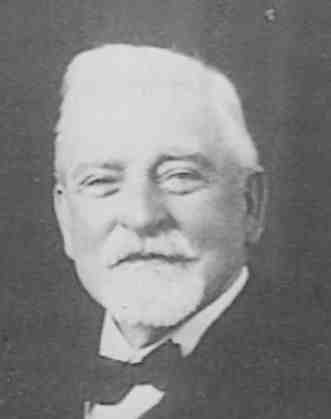
Robert Millis
- Born: 22 Nov 1850, Forgandenny, Perthshire, Scotland, United Kingdom
- Marriage (1): Annie Wylie on 5 Jan 1869 in Thames, Coromandel, Waikato, New Zealand 1 2
- Marriage (2): Mary Ellen Kelly on 6 Oct 1924 3
- Died: 11 Aug 1934, Auckland, Auckland, New Zealand aged 83 4
- Buried: 13 Aug 1934, Auckland, Auckland, New Zealand 5

 General Notes:
He was married at 19 or 20 on the goldfields of Thames (NZ ).
He came to Dunedin as a Printing Engineer and Inventor. He was the printer for one of the local papers - possibly the Otago Evening Star and then about 1888 with his son James, started a firm R. Millis & Son, which carried out engineering activities. (Ref. Comber Index p.247, Patrick Henderson Shipping Co. Lists 1871-1880
p.40)
He traveled to England in 1895 to patent a machine he had invented to make a flat bottomed paper bag, but sold the patent for a pittance and returned to New Zealand. He also invented a machine which harnessed the tide. Through the power of the waves he would get sufficient power to convert to electricity. Although no fault could be found with the machine, no further development took place other than a demonstration at Second Beach, Dunedin.
After his second marriage, he moved to Auckland and died in the 1930's. His eldest son James continued in the Engineering business purchasing premises in Bath St. Dunedin. Expanding in 1932 to include a Motor Garage in Moray Place. After his death in 1946 his sons Robert William, Albert James and later Gerald continued the business in Great King St. The firms were sold in the1970's.
Burial Notes:
There is one gravestone at the family plot
The inscription reads;" Sacred to the memory of James beloved husband of Mary E. Wylie died 5th April, 1924 aged 66 Also of Robert Millis 11th August 1934 aged 83 yrs
also Amelia Kelly, John Kelly, Alice Kelly RIP."
Note date of death on the inscription is different to the death certificate (11th instead of 10th August)
Noted events in his life were:
• Immigration: on The Berwick Castle with his parents, 1852, Auckland City, Auckland, New Zealand.
• Living, 1867, Dunedin, , Otago, New Zealand.
• Occupation: Printer, 1890, Dunedin, , Otago, New Zealand.
• Invention: multiple patents granted, 1892/1910. 1892
An invention for making block-bottom paper bags and entitled "The Simplex Bag-making Machine"24th September
1903
Gold-saving apparatus 14457 18th January
1908
Preparing fibre from Phormium Tenax 23520 25th September
1909
speed-indicator 23054 28th January
sheet-delivering apparatus 23965 30th January
gold-saving process 24089 5th March
flax-catcher 24106 5th March
tire-protector 25064 9th October
1910
lift 28246 10th August
gold-saving 25480 21st January
• Misc: Patent, 1895, London, Middlesex, England, United Kingdom. Robert travelled to London to obtain a patent for the "Simplex" a paper bag making machine \endash he sold the patent before his return.
• Misc, 14 May 1895, Auckland City, Auckland, New Zealand. New Zealand Herald, Volume XXXII, Issue 9819, 14 May 1895, Page 6
Among the visitors at present in Auckland is Mr. Robert Millis, of Dunedin, who is en route via Sydney or England by the S.S. Rotomahana. Mr. Millis is an old Aucklander, who served his apprenticeship in the New Zealand Herald printing office from 1863-8, and is at present foreman machinist of tho Dunedin Evening Star. Mr. Millis, during the past few years has been working the details of a machine called the Simplex," which he has invented for the manufacture of paper bags. Mr. Millis being a practical machinist, well-acquainted by long experience with the handling of paper, the " Simplex" machine is the result of years of thought and experiment, and it was only after attaining what he believed to be a practicable piece of mechanism, combining several special features, that he took steps to patent his invention. Two machines have already been constructed, and both hare been worked in the office of the Dunedin Star for some time. The special features of the "Simplex," as distinct from other bag-making machinery , are : (1) The simplicity of the machine itself, and the means of effecting changes from one size of bag bo the other ; (2) any sized bag, from loz up t*Tl4lb bag, produced from the one machine. The machine will make bags of any quality of paper, from the thin drapers' cap to the heavy grey known as grocers' sugar, or the brown so much favoured by seedsmen. Mr. Millis has patented his invention in New Zealand, Victoria, New South Wales, Great Britain, France, Germany, and the United States. We wish him the success his ingenuity and the merits of bis machine entitle him to. The samples of the work shown to us effectively illustrate the merits of the invention.
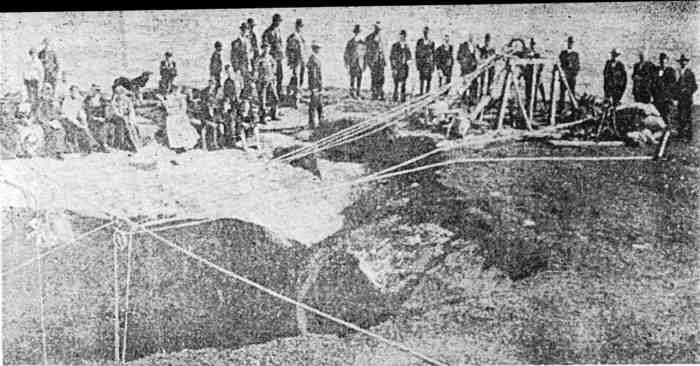
• Invention: Wave harnessing generator, 1903. 6 Note: Descendants of Robert Millis believe that the following is about an invention of Robert Millis, not Robert Miller, as reported. This is not yet proven.
Power from the waves of St Clair
A FRIEND showed me the accompanying photograph, taken about the turn of the century, which shows a group of interested persons watching something unusual going on at a point on the cliffs beyond St Clair. It was a demonstration by a Dunedin inventor to show how he could harness the power of the waves.
The idea of obtaining a workable power of commercial value from the force exerted by the action or movement of the waves has long attracted engineers and inventors the world over. Various ideas have been put forward from time to time, and it is interesting that Dunedin should have made its contribution.
It was in 1903 that a Dunedin man, Robert Miller, patented a method which, according to his own theories and tests, was practical in a limited way. On a Wednesday afternoon in March that year, a group of people gathered at the caves, a mile or so along the coast southward from Cargill Castle at St Clair to see the inventor demonstrate his project.
He had chosen an inlet along this rugged coast at the foot of the sandstone cliffs, and here he had floated a pontoon of logs weighing about six hundredweight with a wire rope attached to each corner. These ropes were led through a series of pulley blocks which were suspended from a cable stretched across the inlet, as can be seen in the photograph.
The ropes were attached to sprocket chains which passed over ratchet wheels running on a spindle. The ratchets were free wheels, similar to the free wheel of a bicycle. Each time the float sunk between the waves, the ropes communicated power to the machine; again in much the same way as when a bicycle pedal is pushed down. The ratchet ran free-when the pontoon rose with each succeeding waves. The power so generated was transmitted by a cog to a flywheel.
Spectators saw the flywheel rotating at a high speed and steadily exerting about one horse-power. The advantage of the ropes being attached to the four corners of the pontoon was that as one corner might be rising another might be falling, so that every movement of the pontoon was turned -to account. There were therefore four rackets on the spindle, one for each rope; :and this supplied a continuity of movement and steadiness to the drive. In order to take up the slack of the chains on their return, counterweights were suspended.
Mr Millis claimed that for each ton of float one horsepower could be gained. He estimated that a 500-ton-float would provide 500 horse-power. He reckoned that in such a large generator, governors and a heavy flywheel would be required to deal with the intermittent power difficulty.
Those present at the demonstration could find no fault in the driving force supplied by the flywheel, which showed no perceptible irregularity. It was Mr Millis's contention that such a machine, set up in a suitable bay on the sea coast, should be able to provide sufficient power to be converted into electricity for use in Dunedin. His intention was to build a larger machine in place of the demonstration one.
At present, no report of this further development of the project has been traced.
I wonder what did happen to Robert Millis's invention
The Otago Daily Times1980 - 1990
By Dunedin historian Hardwicke Knight

• Occupation: Engineer, 1907, Dunedin, , Otago, New Zealand. The following is the wording of an advertisement in Wise's NZ Post Office Directory 1907
R MILLIS & SON
General Engineers & Machinists
19 Bath Street, Dunedin
Engines and Machinery of every description erected and repaired. Machinery Knives and Dies made and re-ground. Plans prepared and Estimates given for Special Machinery. Jobbing Work and Orders of all kinds executed with dispatch.
Telephone No. 506
• Occupation: Engineer, 1912, Dunedin, , Otago, New Zealand. 7
• Retirement, Abt 1916. About 1916 Robert retired and they moved back to Auckland
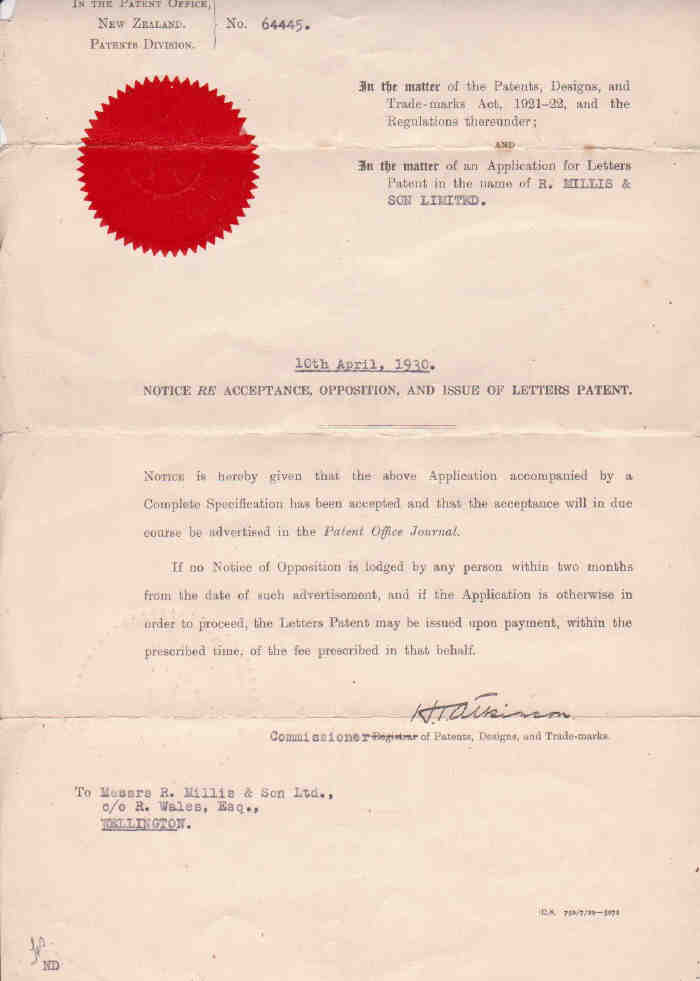
• Invention: Patent granted for improvements in and relating to lifts, 10 Apr 1930.
• Obituary: Otago Daily Times, 13 Aug 1934, Dunedin, , Otago, New Zealand. MR ROBERT MILLIS
The death occurred on Saturday at his residence, Herne Bay, Auckland, of Mr Robert Millia, aged 85 years. Mr Millis was born in Perthshire, Scotland, and was brought to New Zealand as an infant, his parents settling at Thames. He was engaged in mining for some time, and after his marriage, at the age of 18 years, he came to Dunedin, where he was employed in the printing department of the Globe newspaper and later on the Evening Herald. For some time Mr Millis was associated with the printing firm of Messrs Ferguson and Mitchell and lie was then appointed to take charge of the press of-the Evening Star in the days when the. paper was. printed on a flat-bed machine. He .left this position about the year. 1899 and founded the engineering firm of R. Millis and Son in Moray place. He was responsible for the invention of the present type of tea packet with what is called the " block bottom," Previously, tea had been, packed in ordinary paper bags, but Mr Millis's invention' was considered to make a more satisfactory container.; He made a trip to the Old Country to secure the patent rights for his invention, which he sold before returning to the Dominion. Mr Millis retired from his business 16 years ago and' went to Auckland, where he accepted a position with the New Zealand Bag and Sack Company, remaining with the firm until the time of his death, which was preceded by a brief illness. He was predeceased by his wife 12 years ago and one son (Mr A. E. Millis) was killed in the Great War.He is survived by a family of three sons\emdash Mr R. J. Millis, of Balclutha, and Mr J. H.. Millis and Mr E. Millis, of Dunedin\emdash and four daughters\emdash Mrs H. Burmester, of Stratford, Mrs H.Miscal, of Takapuna, Auckland, Mrs E. Dyer, of Auckland, and Mrs O. Schuberg, of Taumarunui.
• Obituary: Taranaki Daily News, 18 Aug 1934. DEATH OF INVENTOR
MR. ROBERT MILLIS, AUCKLAND. FATHER OF STRATFORD RESIDENT, Advice of the death of her father, Mr. Robert Millis, at Herne Bay, Auckland, has been received by Mrs. H. Burmester, Stratford. During his life Mr. Millis was connected with several well known New Zealand newspapers, and he was familiar to Dunedin people as founder of an engineering firm there. Of Mr. Millis the Dunedin Evening Star, by whom he was for some time employed, said: "He is remembered with sincere respect as for many years in charge of the machine department. He was an exceptionally skilful artisan, capable of controlling responsibility, resourceful in an emergency, always ready to apply the inventions with the perfecting of which he was for ever occupied, and withal a man of high character. The late Mr. Millis was bom in Perthshire in February, 1850, and was two years of age when brought to Auckland by his parents. They settled at Thames, where as a boy he worked at goldmining. He married when only 18 years old, and was employed first in the machine room of the Southern Cross, and later as machinist in the New Zealand Herald office. At Dunedin he was employed for a time with the Globe newspaper, then with the Evening Herald and later the Evening Star. He was in charge of the machine department in each of those offices. While with the Star he invented the block-bottom tea packet, and he travelled to Great Britain to secure the patent rights, which he sold before returning to New Zealand. On his return he founded the firm of R. Millis and Son in Moray Place, Dunedin. Sixteen years ago he retired from the business in favour of his son James, and went to Auckland. Ten weeks ago he fell suddenly ill, and his condition became steadily worse until his death on Saturday, August 11. His first wife died 12 years ago.
MAKING PAPER BAGS BY MACHINERY: 2 May 1895
Otago Witness, Issue 2149, 2 May 1895, Page 12
A COLONIAL PATENT.
We have had an opportunity of inspecting a new machine, invented by Mr Robert Millis, foreman machinist at the Evening Star office. This machine, named the " Simplex," has been working with very satisfactory results for some months, and it is now the intention of Mr Millis to proceed to Brita'n and place it upon the market there. Many of our readers will remember the three - cornered paper bag generally used in the " auld lang syne." This was simply a square piece of paper deftly twisted into the shape of a bag. The next step in advance was what is generally known as the " side-seam " bag, to make which several machines have been placed upon the market. Then came the "satchel," "pocket," "union," and many o'her kinds. Mr Millis being a practical machinist, well acquainted by long experience with the handling of paper, the " Simplex " machine is the result of years of thought aud experiment, and it was only after attaining what he believed to bo a practicable piece of mechanism, combining several special features, that he took steps to patent his invention. Two machines have already been constructed, and both have been worked in the office of our contemporary for some time.
The special features of the " Simplex " as distinct from other paper bag-making machinery are (1) the simplicity of the machine itself, and the means of changing from one size of bag to another; (2) its extensive range\emdash we noticed bags made upon it as small as a 1oz tobacco and as large as a 14lb sugar, with all the intermediate sizes ; (3) it is comparatively inexpensive. The machiue is worked by two lads, the one "feeding," the other "taking off." The paper is first cut square to the required size\emdash no angle-cutting as in the side-seam bag \emdash and the heap of paper is placed in position under the pasting roller. Ass each sheet; is automatically pasted it is fed to gauges, when a die descends and carries it into a receptacle, where folders complete" the process of making the bag. The die then ascends and the taker-off removes the made bag from the die and places it under a roller and blade, which form the block bottom and break down the bag for packing. This is the whole process, the bags being then passed on to a drying cylinder, where they are retained for a sufficient time to dry the paste. The machine is particularly adapted for making square bags, printed upon all four sides, such as tea packers use in making up their teas for the market. While this m
ANGLO-COLONIAL NOTES. : 13 Feb 1896, Glasgow, Lanark, Scotland, United Kingdom
PERSONAL NOTES. London, December 28.
Mr Robert Millis, of Dunedin, has succeeded in impressing the merits of his paper-bag-making machine on experts in England, and a syndicate entitled " The Simplex Paper-Bag Syndicate, Limited," has been formed to exploit the invention. Mr Millis is under engagement to them from January 1st for two years, and a number of machines have been ordered fiom Jas. Milline and Sons, of Edinburgh. This tirm have, under the inventor's superintendence, already manufactured two sample machines, one of which will shortly be visible at work in London. Mr Millis* headquarters next year are to be in town, but he has gone to Glasgow for the holidavs.
Power from the waves: 1 Apr 1903, Dunedin, , Otago, New Zealand
Otago Witness, Issue 2559, 1 April 1903, Page 11
The report misnames Robert Millis as Robert Miller throughout so this may not be a story relating to Robert Millis, although he an inventor in Dunedin at the time.
POWER FROM THE WAVES.
A LOCAL INVENTION.
The idea of obtaining a workable power of commercial value from the force exerted by the action or movement of the waves of the sea lid-, long had an attraction for engineers and inventors the world over, and there has now been patented by a Dunedin inventor (Mr Robert Miller) a method by which the difficulty seems to be solved. On Wednesday afternoon, at the invitation of the inventor, a number of Dunedin gentlemen proceeded to the Caves, about a mile along the south coast from St. Clair, and there inspected Mr Miller's invention at work. The spot is one excellently adapted for the purpose, the coast being rough and broken by numerous small bays and coves. In one small inlet Mr Miller has floated a pontoon of logs, about 6cwt in weight, and to each corner of this float is attached a wire rope: these ropes are led through pulley blocks suspended from a wire cable stretched across the cove directly above, and thence to the power machine, being attached to sprocket chains passing over ratchet wheels, which run upon a spindle. The ratchets are virtually free wheels, the downward pull on the ropes communicating power, and each ratchet running free as its particular rope is slackened by the rising of the corner of the float to which the rope is attached. The power thus exerted is communicated by means of a cog to the fly wheel shaft, and the small fly wheel in use yesterday rotated at a high speed, and vith a most satisfactory degree of. steadiness, exerting about one horse-
power. It will be seen that, a rope being attached to each corner of the float, enables
every movement or quiver of the pontoon to be turned to account, as sometimes one corner is rising while another is falling. The ratchets run freely on the spindle, but, being' fitted with pawls or check fingers, which drop into fixed cogs on the same spindle upon the downward null, they thus communicate the same degree of power as they receive force of pull to the fixed cogs, which in turn communicate it to the fly wheel shaft. The sprocket chains, after passing over the ratchets, are kept in position by vertically suspended Weights, so that there is no slack chain. There are four ratchets on the spindle, one for each rope from each corner of the float ; and this principle seemed to supply that steadiness and continuity of motion requisite to turn wave power to account. It is estimated that for each ton of float one horse-power is gained, thus a 500-ton float would communicate 500 horse-power if communicated by powerful automatic governors and heavy fly wheel, which combination deals with the intermittent power difficulty.
Those present yesterday, though they examined the machine very carefully and closely, could find no fault with its working, as the fly wheel was running smoothly at a high speed and with no perceptible break or slackening in its revolutions. At the site selected, by the stretching of a wire rope across one small bay. it would be possible to work an unlimited weight of pontoons, and consequently to obtain unlimited power, to be converted into electricity for communication to Dunedin. Mr Miller proposes to erect a larger machine in place of the temporary structure at present used, and, with the power generated, to drive some machinery with a view to giving a practical, demonstration of the utility of his invention to the public at large, and when this is ready an invitation to inspect the apparatus will be extended to the public generally.
Robert married Annie Wylie on 5 Jan 1869 in Thames, Coromandel, Waikato, New Zealand.1 2 (Annie Wylie was born on 5 May 1853 in Glasgow, Lanark, Scotland, United Kingdom and died on 28 Dec 1922 in Auckland, Auckland, New Zealand 8.)
Noted events in their marriage were:
• Residence, 1893, Dunedin, , Otago, New Zealand. Eden Street, Dunedin Central
• Residence, 1906, Dunedin, , Otago, New Zealand. 130 Maitland Avenue, Dunedin
• Residence, 1911, Dunedin, , Otago, New Zealand. 272 Main Road, Normandy, Dunedin
Robert next married Mary Ellen Kelly on 6 Oct 1924.3 (Mary Ellen Kelly was born in 1872 in Manchester, Lancashire, England, United Kingdom and died in 1958 in Auckland, Auckland, New Zealand 9.)
|